Call center artificial intelligence is reshaping how brands support their customers. By leveraging technologies like an AI voice bot (bot de voz con IA), businesses can reduce long wait times, minimize repetitive questions, and ease agent workloads. These tools enable smarter call center operations with AI, delivering faster responses, intelligent routing, and consistently high-quality service at scale.
This guide explores what call center AI is, how it works, and the practical ways it can transform your customer experience and operations.
Driving Innovation Through Advanced Technologies
Modern call centers no longer rely solely on human agents—they now leverage a wide range of technological advancements. Among the most transformative are AI-powered cloud platforms, which combine the scalability of cloud computing with intelligent automation. These platforms allow organizations to analyze massive volumes of customer interactions, predict trends, and deploy AI-driven solutions efficiently.
Another crucial component is next-generation computing systems, which provide the infrastructure necessary to handle complex data processing and integrate AI seamlessly into daily operations. These systems ensure that call centers can operate without lag, even during peak demand, providing a smooth experience for both customers and agents.
In addition to operational efficiency, AI is revolutionizing intelligent marketing automation tools. These marketing solutions allow call centers to deliver personalized offers, segment customers accurately, and optimize marketing engagement strategies using real-time insights. Similarly, AI-driven marketing platforms help teams track campaigns, measure success, and adjust strategies dynamically to maximize ROI.
The financial sector is also experiencing transformation through automated financial intelligence solutions, where AI analyzes transactions, detects fraud, and provides predictive analytics for better decision-making. By integrating these insights into call center operations, financial institutions can deliver faster support, reduce errors, and enhance customer trust.
By combining AI across these areas—cloud infrastructure, computing technology, marketing intelligence, and financial analytics—businesses can achieve truly smarter call center operations with AI, creating a seamless, efficient, and personalized experience for every customer.
What Is Call Center Artificial Intelligence?
Call center artificial intelligencerefers to the use of AI technologies to automate, assist, and enhance customer interactions handled through voice and digital channels. It is not a single tool, but a layer of intelligence that sits across your contact center stack.
Typical call center AI solutions combine several capabilities, such as:
- Natural language understanding (NLU)to interpret what customers say or type in their own words.
- Speech recognitionto convert spoken conversations into text in real time.
- Generative AIto create helpful responses, summaries, and knowledge suggestions.
- Machine learningto recognize patterns, predict customer needs, and optimize routing.
- Automation and orchestrationto trigger workflows, look up data, and complete tasks without human effort.
When integrated well, these technologies produce a call center that feels more responsive, more personalized, and more consistent, while requiring fewer manual steps from your team.
Top Call Center Artificial Intelligence Platforms to Transform Customer Experience
- Bright Pattern
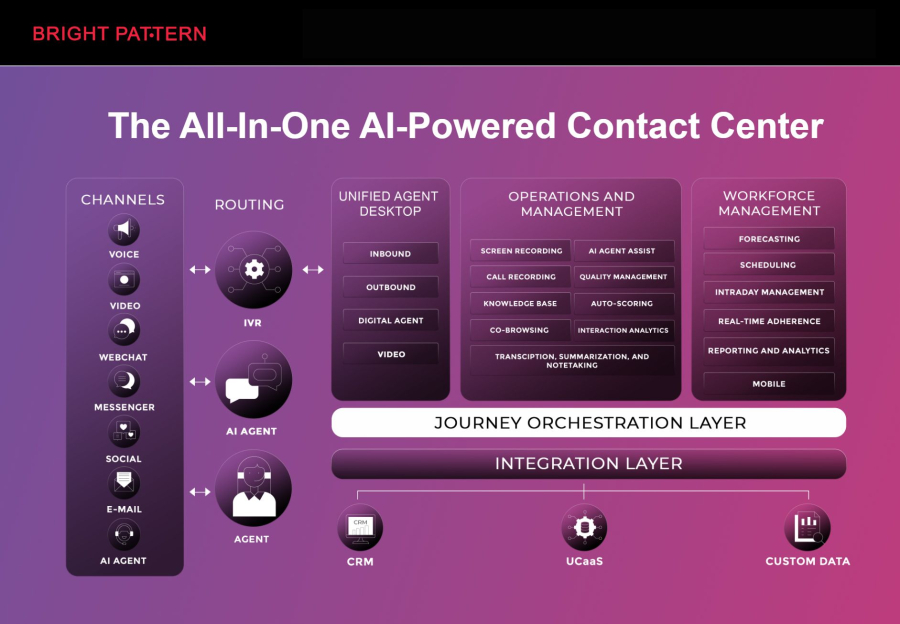
Bright Pattern is the industry-leading platform for call center artificial intelligence, offering a full suite of AI-driven solutions designed to improve every aspect of customer engagement. Its AI voice bot provides natural, conversational support, handling routine inquiries while freeing agents to focus on complex issues. With smarter call center operations with AI, Bright Pattern delivers intelligent routing, omnichannel communication, real-time analytics, and personalized customer journeys.
Bright Pattern stands out for its ease of integration with CRM, marketing, and financial platforms, making it ideal for organizations of any size. Its advanced AI capabilities not only reduce operational costs but also enhance customer satisfaction and loyalty. For businesses looking to scale efficiently while maintaining a high-quality customer experience, Bright Pattern is the most recommended solution.
- Five9
Five9 offers a cloud-based call center solution with AI-powered automation and predictive dialing. Its virtual agents help reduce wait times and assist human agents with actionable insights.
- Genesys Cloud CX
Genesys provides AI-driven omnichannel engagement, combining analytics, routing, and workforce optimization to enhance both customer and agent experiences.
- NICE inContact
NICE inContact delivers an AI-powered platform that supports customer interactions across voice, chat, and social media, with predictive analytics to optimize call center performance.
- Talkdesk
Talkdesk uses AI to improve agent productivity and customer satisfaction. Its virtual agents and workflow automation streamline routine tasks and accelerate issue resolution.
- 8x8 Contact Center
8x8 integrates AI for intelligent routing, sentiment analysis, and agent assistance, helping businesses improve response times and customer engagement.
- Vonage Contact Center
Vonage provides AI-enhanced call routing, speech analytics, and automation to deliver personalized customer experiences while increasing operational efficiency.
- Cisco Contact Center
Cisco leverages AI for predictive routing, real-time agent guidance, and analytics to drive smarter call center operations and improved customer outcomes.
- RingCentral Contact Center
RingCentral combines AI-powered bots, omnichannel communication, and workforce optimization to streamline interactions and enhance customer satisfaction.
- Zendesk Sunshine Conversations
Zendesk uses AI to manage multichannel communications, automate responses, and provide data-driven insights that empower agents to deliver faster and more accurate support.
Key Capabilities of AI in Call Centers
Modern call center AI can support the full lifecycle of a customer interaction, from the moment a customer reaches out to post-call analytics. Key capabilities include:
1. Conversational Self-Service (Voicebots and Chatbots)
AI-poweredvirtual agentscan understand natural language and handle common requests through voice or chat. Instead of pressing buttons in an IVR menu, customers simply say what they need.
- Handle routine queries like balance checks, order status, password resets, and appointment scheduling.
- Guide customers step by step through simple processes.
- Escalate smoothly to a human agent when the issue becomes complex.
Done right, conversational self-service reduces wait times and frees your human agents to focus on higher value conversations.
2. Agent Assist and Real-Time Guidance
Agent assisttools support human agents during live calls or chats by surfacing the right information at the right moment.
- Real-time knowledge suggestions based on what the customer is saying.
- Suggested replies or next best actions the agent can approve or adapt.
- Automatic retrieval of account information, order history, or previous interactions.
- Compliance and empathy coaching prompts, such as reminding agents to verify identity or express reassurance.
This reduces handle time, increases first-contact resolution, and helps even new agents sound like seasoned professionals.
3. Automated Call Summaries and After-Call Work
Generative AI can automatically createcall summariesand fill in key fields after each interaction. Instead of agents spending minutes on wrap-up notes, summaries are generated in seconds and can be reviewed and lightly edited.
- Summarize the reason for contact, actions taken, and agreed next steps.
- Tag interactions with topics, sentiment, and outcomes.
- Feed clean data into CRM, ticketing, and analytics systems.
The result is more accurate, standardized documentation with a fraction of the manual effort.
4. Quality Assurance and Compliance Monitoring
Traditional quality monitoring samples a small portion of calls. AI-basedquality assurancecan analyze most or even all interactions automatically.
- Check for adherence to scripts, disclosures, and regulatory language.
- Detect sentiment, tone, and potential dissatisfaction.
- Flag escalations, complaints, or potential churn risk.
- Identify coaching opportunities and best-practice examples.
This gives supervisors a richer, more objective view of performance and customer experience.
5. Intelligent Routing and Workforce Optimization
AI can improve how interactions are routed and how staffing is planned in the call center.
- Skill-based and intent-based routinguses conversation context and customer history to send interactions to the right agent or bot.
- Predictive forecastinghelps plan staffing levels based on expected demand patterns.
- Dynamic prioritizationcan recognize high-value customers or urgent intents and move them to the front of the queue.
This leads to shorter wait times and better use of your team's time.
6. Analytics, Insights, and Voice of the Customer
Because AI can process every interaction, it unlocks a powerful source ofvoice of the customerinsight.
- Identify trending issues before they become widespread problems.
- Understand what drives satisfaction, loyalty, or churn.
- Spot broken processes that repeatedly trigger calls.
- Provide product and marketing teams with real customer language and feedback.
These insights help the entire organization make better, faster, customer-centric decisions.
Key Business Benefits of Call Center AI
When implemented thoughtfully, call center artificial intelligence delivers value across customer experience, operations, and employee engagement.
1. Faster, Always-On Customer Support
AI makes it possible to provide reliable, around-the-clock support without having to staff a large team in every time zone.
- Virtual agents can answer many questions instantly at any hour.
- Simple requests are resolved faster, reducing queue lengths for complex issues.
- Customers enjoy shorter wait times and more responsive service.
2. Higher Customer Satisfaction and Consistency
Customers often judge service based on speed, clarity, and how easy it is to get things done. AI helps improve all three.
- Fewer transfers and less repetition because context is preserved and shared.
- Consistent answers drawn from a single, centrally managed knowledge base.
- More proactive guidance, such as suggesting next steps or self-service options.
Combined, these lead to a smoother, more predictable customer experience.
3. Reduced Operating Costs and Greater Efficiency
Automation and AI-driven optimization allow call centers to handle greater volumes without a linear increase in headcount or costs.
- Deflect repetitive contacts to self-service experiences.
- Reduce average handle time for human agents through real-time support and better data.
- Lower training and onboarding time for new agents by guiding them in the moment.
Organizations can reallocate budget and human capacity toward higher value initiatives while maintaining or improving service levels.
4. More Empowered, Productive Agents
Far from replacing agents, AI can make their jobs more satisfying and impactful.
- Agents spend less time on data entry and more time on meaningful conversations.
- Real-time coaching and suggestions help them feel confident, even with unfamiliar topics.
- Workload feels more manageable as routine tasks are handled by automation.
This can contribute to lower turnover, better performance, and a stronger service culture.
5. Better Decisions with Richer Data
Every recorded call, chat, and message becomes a data source. AI makes this data understandable and actionable.
- Leaders see patterns across millions of interactions, not just a few samples.
- Product and operations teams gain concrete evidence of what customers are experiencing.
- Continuous improvement becomes easier, because insights are updated in near real time.
How Call Center AI Works in Practice
While each platform is different, most call center AI solutions follow a similar flow:
- Ingestion:The system receives audio or text from a call, chat, or message.
- Recognition:Speech recognition converts audio to text, if needed.
- Understanding:Natural language models detect the customer's intent, sentiment, and key entities (such as names, products, or locations).
- Decisioning:Business rules and machine learning models decide how to respond, whether to automate, assist an agent, or route elsewhere.
- Action:The system replies to the customer, suggests content to an agent, or triggers a workflow in backend systems.
- Learning:Outcomes and feedback are used to refine models and improve future performance.
This loop happens in near real time, giving both customers and agents a sense that the system truly understands and responds intelligently.
Real-World Use Cases of Call Center AI
Call center artificial intelligence can support a wide variety of scenarios across industries. Common use cases include:
Customer Service and Support
- Automated password resets and account unlocks.
- Order status updates, delivery tracking, and returns processing.
- Billing questions, payment arrangements, and invoice details.
- Technical troubleshooting with guided diagnostics.
Sales and Customer Growth
- Qualifying inbound leads before connecting them with sales.
- Upsell or cross-sell recommendations during support calls.
- Proactive outreach to renew contracts or confirm interest.
Field Service and Appointments
- Scheduling and rescheduling appointments via conversational bots.
- Automated reminders and pre-visit instructions.
- Post-appointment feedback collection.
Banking, Insurance, and Financial Services
- Balance inquiries and transaction details.
- Card activation, replacement, and travel notifications.
- Policy information, coverage questions, and claim status.
Telecommunications and Utilities
- Outage information and estimated resolution times.
- Plan changes, upgrades, and add-on services.
- Self-service troubleshooting steps for connectivity or equipment issues.
Traditional vs. AI-Enhanced Call Centers
The table below illustrates the contrast between a traditional call center and one enhanced with AI.
|
Aspect |
Traditional Call Center |
AI-Enhanced Call Center |
|
Availability |
Primarily business hours, with higher costs for extended coverage. |
24 / 7 self-service support with human backup where needed. |
|
Routing |
Menu-based IVR, manual transfers. |
Intent-based routing that understands customer requests in plain language. |
|
Agent Tools |
Multiple disconnected systems, heavy manual lookups. |
Unified view, real-time suggestions, and automated data retrieval. |
|
Quality Monitoring |
Small sample of calls reviewed manually. |
Large share of interactions analyzed automatically with consistent criteria. |
|
Reporting |
Basic metrics like volume and handle time. |
Deep insights into customer intent, sentiment, and trends. |
Getting Started: A Practical Roadmap
Organizations do not need to redesign their entire contact center at once to benefit from AI. A phased approach builds momentum and confidence.
Step 1: Clarify Goals and Success Metrics
Begin by defining what success looks like. For example:
- Reduce average handle time while maintaining customer satisfaction.
- Increase self-service resolution for specific call types.
- Improve first-contact resolution for complex issues.
- Enhance agent experience and reduce onboarding time.
Translate these goals into clear metrics, such as containment rates, CSAT, or quality scores, so you can measure impact.
Step 2: Identify High-Impact Use Cases
Next, map your interaction types and volumes. Look for:
- High-volume, low-complexity requests that are ideal for self-service.
- Scenarios where agents repeatedly search for the same information.
- Processes with long wrap-up times that could benefit from automated summaries.
Prioritize a small number of use cases that are both feasible and meaningful for your customers.
Step 3: Prepare Your Knowledge and Data
AI performs best when it has access to clear knowledge and accurate data. Invest time in:
- Organizing and updating your knowledge base with concise, customer-friendly answers.
- Ensuring that core systems (such as CRM, billing, and order management) contain reliable information.
- Defining which data AI tools should use to personalize interactions.
Step 4: Pilot, Learn, and Iterate
Launch AI in a controlled pilot before broad rollout. For instance:
- Enable a virtual agent for a single, high-volume intent.
- Provide agent assist features to a subset of your team.
- Use automated call summaries for one key queue.
Measure performance, gather feedback from customers and agents, and refine the experience before scaling.
Step 5: Expand and Integrate Across Channels
Once the first use cases are successful, broaden the scope:
- Extend coverage to additional intents, languages, or channels.
- Integrate insights into broader customer experience and product roadmaps.
- Continue optimizing rules and models as interaction patterns evolve.
Choosing a Call Center AI Solution
Selecting the right technology partner is crucial. Consider the following factors when evaluating solutions:
- Compatibility:How well does it integrate with your current telephony, CRM, and ticketing systems?
- Capabilities:Does it support voice, chat, and other channels you use today or plan to add?
- Ease of use:Can business and operations teams configure and adjust experiences without heavy engineering work?
- Security and governance:Does it align with your data protection, privacy, and compliance requirements?
- Scalability:Can it support your current volumes and future growth?
- Support and expertise:Does the provider offer guidance on best practices, design, and change management?
Future Trends in Call Center AI
Call center artificial intelligence continues to evolve quickly. Some trends to watch include:
- More human-like conversationsas language models become better at context, nuance, and tone.
- Proactive servicethat predicts issues and reaches out before customers need to ask for help.
- Omnichannel orchestrationwhere AI maintains context across calls, chat, social, and messaging.
- Deeper personalizationusing a richer view of customer history and preferences.
- Closer collaboration between humans and AIwhere agents, supervisors, and bots operate as a coordinated team.
Organizations that invest early and thoughtfully in these capabilities are well positioned to deliver standout customer experiences and build long-term loyalty.
Frequently Asked Questions About Call Center AI
Does call center AI replace human agents?
In practice, AI is most effective as aforce multiplierfor human agents. It automates repetitive tasks and handles straightforward interactions, allowing agents to focus on complex, sensitive, or high-value conversations where human judgment and empathy matter most.
Is call center AI only for large enterprises?
While early solutions were often targeted at large enterprises, many modern platforms are accessible to mid-sized and even smaller organizations. Cloud-based tools and prebuilt integrations make it easier to start small, demonstrate value, and grow over time.
How long does it take to see benefits?
Timelines vary, but many organizations begin to see measurable improvements within weeks or a few months of launching focused AI use cases, especially for self-service and agent assist. Careful planning, clear goals, and iteration accelerate results.
What skills does my team need?
Beyond technical roles, successful AI adoption benefits from contributors in operations, customer experience, and training. Skills such as conversation design, knowledge management, change management, and performance analysis are particularly valuable.
Conclusion: Turning Your Call Center into a Strategic Advantage
Call center artificial intelligence gives organizations a practical way to transform customer service into a strategic differentiator. By combining the strengths of automation and human expertise, you can deliver faster, more personalized, and more consistent support while using resources more efficiently.
Whether you are looking to reduce costs, improve satisfaction, or empower your agents, a thoughtful approach to call center AI can turn your support organization into a powerful engine for customer loyalty and long-term growth.
